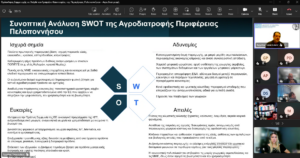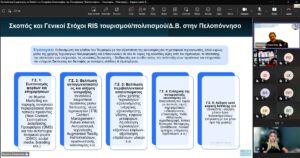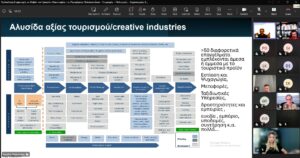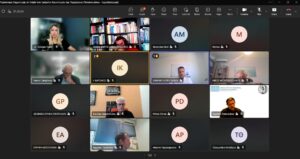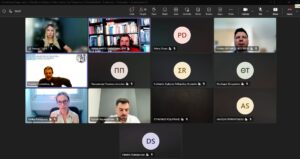

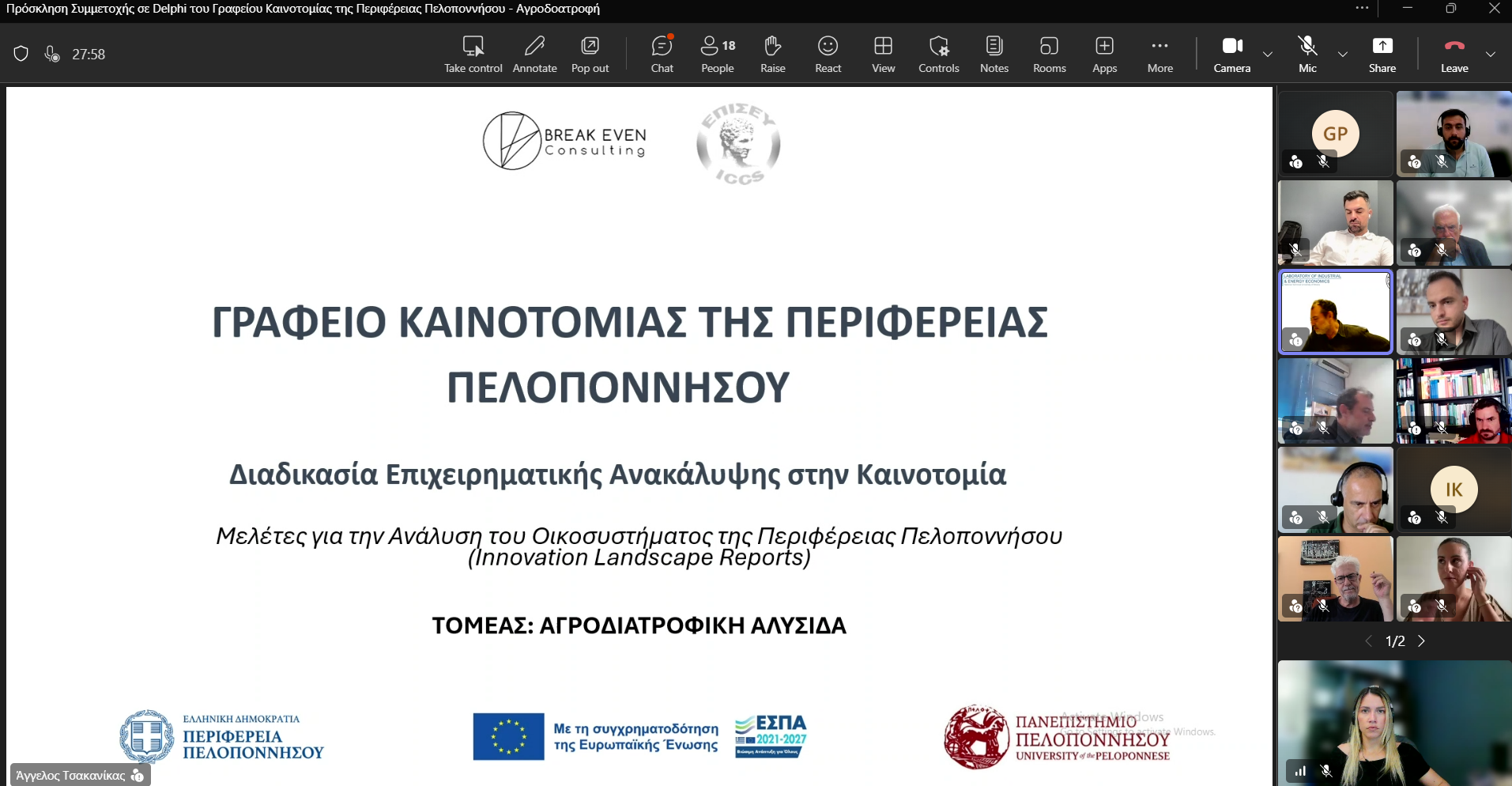
The Innovation Office of the Region of Peloponnese held two working meetings with the participation of experts from the academic, research and business communities, as part of the needs analysis and the assessment of the regional innovation ecosystem. The process focused on two key priority areas of the Region’s Smart Specialisation Strategy (RIS3), the Agri-food Sector and the Tourism, Culture and Creative Industries Sector.
The meetings were structured around the Delphi method, a well-established forecasting technique that draws on the specialised knowledge of experts in order to gather views on the future needs, trends and challenges emerging in each sector. It was conducted through successive rounds of questions, in which participants submitted their forecasts, with the aim of gradually converging towards shared and well-founded positions. This approach allows both the points of consensus and the divergences among participants to be identified, strengthening the reliability of the conclusions that emerge.
The results of the process will contribute to identifying areas with high innovation potential, as well as to formulating evidence-based policy proposals that will support the design of the Region’s development strategy during the current programming period and will inform decision-making for the next one. The findings will be incorporated into the relevant studies mapping the regional ecosystem (Innovation Landscape Reports), forming a comprehensive picture of the needs, capacities and opportunities for strengthening innovation within each thematic axis.
The Innovation Office extends its warm thanks to all the experts who took part in the two working meetings, for the time they devoted and for the expertise they shared on both the Agri-food Sector and the Tourism, Culture and Creative Industries Sector. Their in-depth knowledge of the individual fields, their critical perspective and their substantive contribution to every round of the process were decisive for the quality and the soundness of the results. Our thanks go, in alphabetical order, to Mr Nikos Apostolopoulos, Ms Eirini Askoxylaki, Mr Sotiris Varelas, Mr Ioannis Giotopoulos, Mr Vasilis Dimopoulos, Mr Georgios Iliadis, Mr Yannis Kalogirou, Mr Ioannis Kaplanis, Mr Ioannis Kapolos, Ms Alexandra Mari, Mr Georgios Panoutsopoulos, Mr Antonis Papadopoulos, Ms Aimilia Protogerou, Mr Stylianos Rodarelis, Ms Angeliki Spyropoulou, Mr Marios Chronis and Mr Charalampos Chrysomallidis.
Particular thanks are due to Mr Angelos Tsakanikas, Professor of Economic Evaluation of Technology, Innovation and Entrepreneurship Systems at the National Technical University of Athens and Director of the Laboratory of Industrial and Energy Economics (LIEE), for coordinating the two working meetings and for his methodological guidance throughout the process.
For the preparation and organisation of the meetings, the Innovation Office warmly thanks Ms Georgia Tsami, Deputy Project Coordinator, as well as the LIEE NTUA team, Ms Theodora Tzoumanika, Mr Petros Dimas, Mr Dimitris Stamopoulos and Mr Panagiotis Panagiotopoulos.
Learn more about the Innovation Office:
Instagram: https://www.instagram.com/ppel.innovation/?hl=en
LinkedIn: https://www.linkedin.com/company/peloponnese-innovation-office
Facebook: https://www.facebook.com/share/1Fuog1zCC6/?mibextid=wwXlfr
The project is implemented within the framework of the Action “Support actions for entrepreneurial discovery through the collaboration of Regional Business and Research Organizations (Innovation Office)”, with MIS code 6011212. The Action is part of the “Peloponnese 2021–2027” Programme and is co-financed by the European Union (European Regional Development Fund) and national resources through the Public Investment Programme. The Contracting Authority is the University of the Peloponnese.